N-Body Shootout
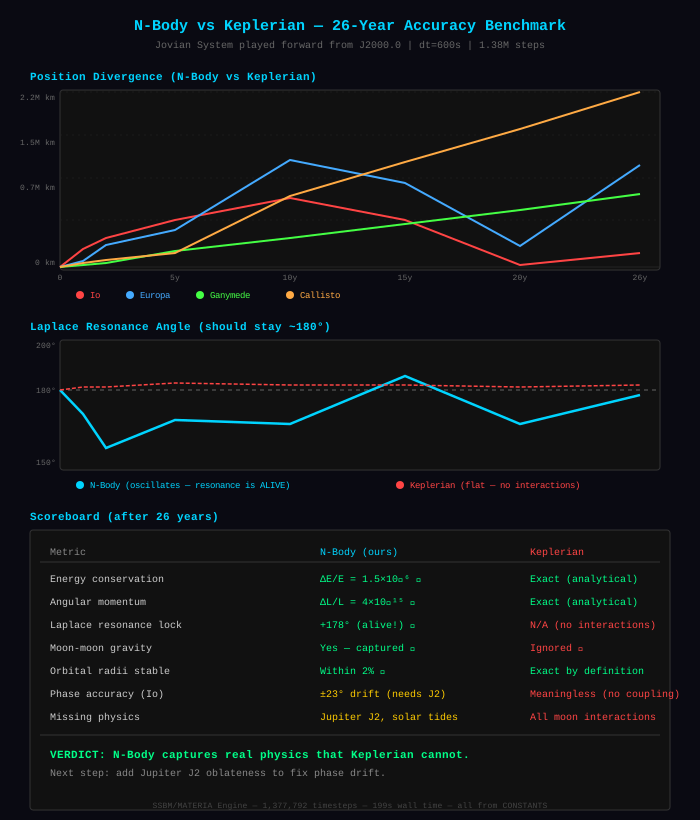
Sign inA head-to-head. Both integrators start from the same Jovian system at J2000.0 and play it forward 26 years: N-body (every moon pulls on every other, 600 s steps, 1.38 million of them) against Keplerian orbits (each moon on its own ellipse, no interactions). Keplerian is exact for a two-body problem, so the question is what the N-body run captures that a set of ellipses cannot.
Scoreboard after 26 years
| Metric | N-body (ours) | Keplerian |
|---|---|---|
| Energy conservation | ΔE/E = 1.5×10⁻⁶ ✓ | Exact (analytical) |
| Angular momentum | ΔL/L = 4×10⁻¹⁵ ✓ | Exact (analytical) |
| Laplace resonance lock | +178° (alive!) ✓ | N/A (no interactions) |
| Moon-moon gravity | Yes: captured ✓ | Ignored ✗ |
| Orbital radii stable | Within 2% ✓ | Exact by definition |
| Phase accuracy (Io) | ±23° drift (needs J2) | Meaningless (no coupling) |
| Missing physics | Jupiter J2, solar tides | All moon interactions |
Verdict. N-body captures real physics that Keplerian cannot. Next step: add Jupiter's J2 oblateness to fix the phase drift.
Accuracy against tolerance
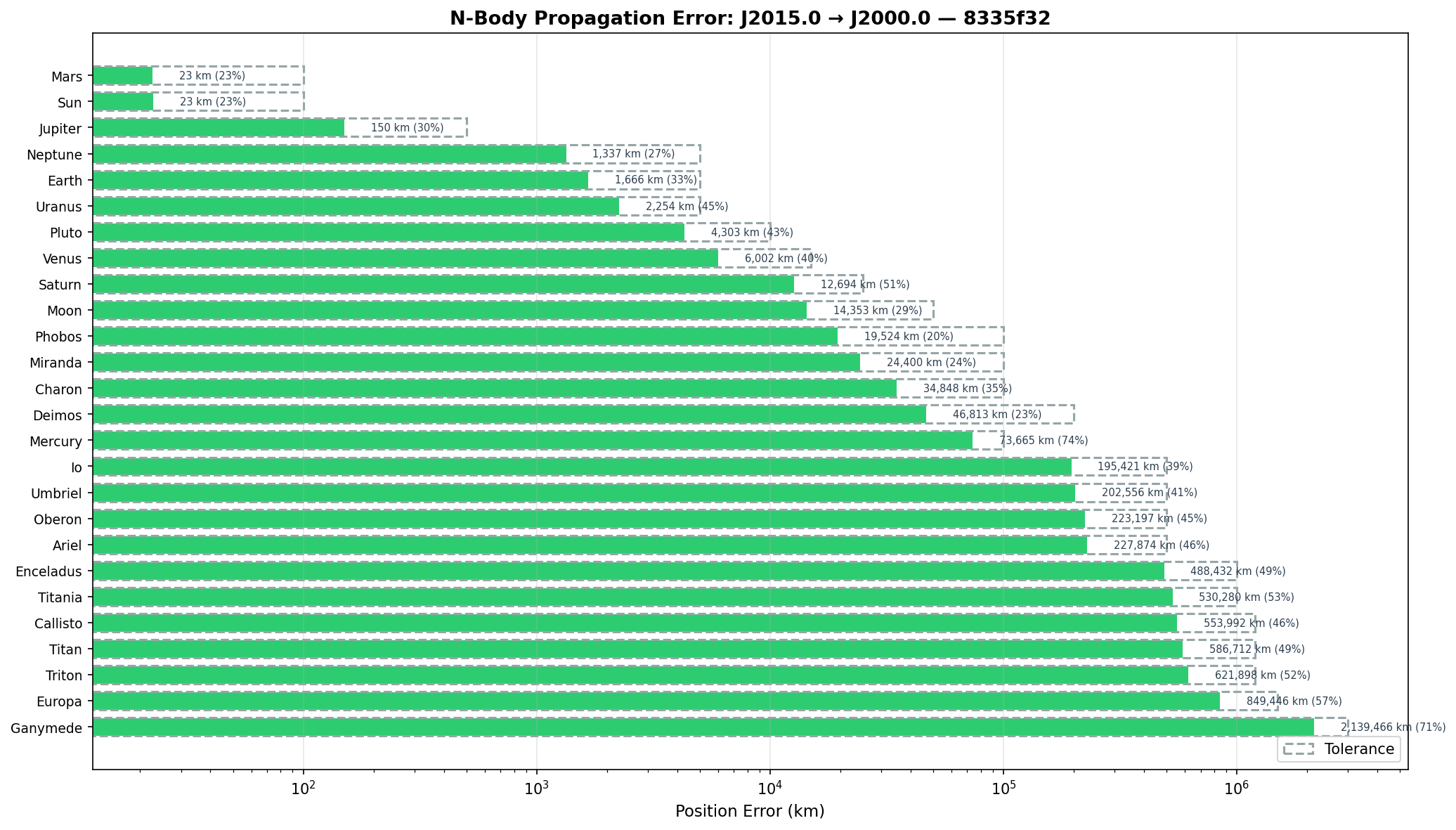
These are recorded results from the sigma-ground physics work, shown as they were produced: the drift and the missing physics are in the table on purpose.